Why Certified Arborists Don’t Use Climbing Spikes for Routine Tree Pruning
When homeowners hire a tree service company, they often focus on price, availability, or whether the company can complete the job quickly. However, the techniques used during pruning can have a significant impact on the long-term health of your trees.
One practice that separates professional arborists from less experienced tree workers is the use (or avoidance) of climbing spikes during routine tree pruning.
At Powell’s Tree Care, we follow industry best practices and use spike-less pruning techniques whenever possible to protect the health and longevity of the trees we care for throughout Greene County and the surrounding area.
What Are Climbing Spikes?
Climbing spikes,are metal spikes attached to a climber’s boots. They allow a tree worker to ascend a tree by repeatedly puncturing the bark and underlying tissue.
While spikes can be an effective tool in certain situations, they should not be used on healthy trees that are being pruned and preserved.
Every step taken with climbing spikes creates a wound in the tree’s bark. Depending on the size of the tree and the work being performed, hundreds of punctures may be made during a single climb.
When Are Climbing Spikes Appropriate?
There are situations where climbing spikes are considered acceptable and necessary.
Spikes are commonly used during:
- Tree removals
- Hazard tree removals
- Emergency storm damage work
- Dead tree removals
In these situations, preserving the tree’s health is no longer the primary concern because the tree is being removed or has already died.
For healthy trees receiving routine maintenance, industry standards recommend alternative climbing methods whenever possible.
Why Certified Arborists Avoid Climbing Spikes During Routine Pruning
Certified arborists are trained to prioritize tree health and follow pruning practices supported by industry research and standards.
Using climbing spikes on healthy trees can:
Create Unnecessary Wounds
Every puncture breaks through the bark, which serves as the tree’s natural protective barrier. These wounds can take time to seal and may create entry points for insects, fungi, and disease.
Increase Stress on the Tree
Trees already experience stress from environmental factors such as drought, storms, pests, and construction activity. Additional wounds caused by spikes can increase that stress and impact overall health.
Leave Visible Damage
In some species, spike wounds can remain visible for years and affect the tree’s appearance. This can be especially concerning for mature shade trees and ornamental trees that contribute significantly to a property’s curb appeal.
Compromise Long-Term Health
While a healthy tree can often recover from a small number of wounds, repeated spike damage over time may increase vulnerability to decay and disease.
What Is Spike-less Pruning?
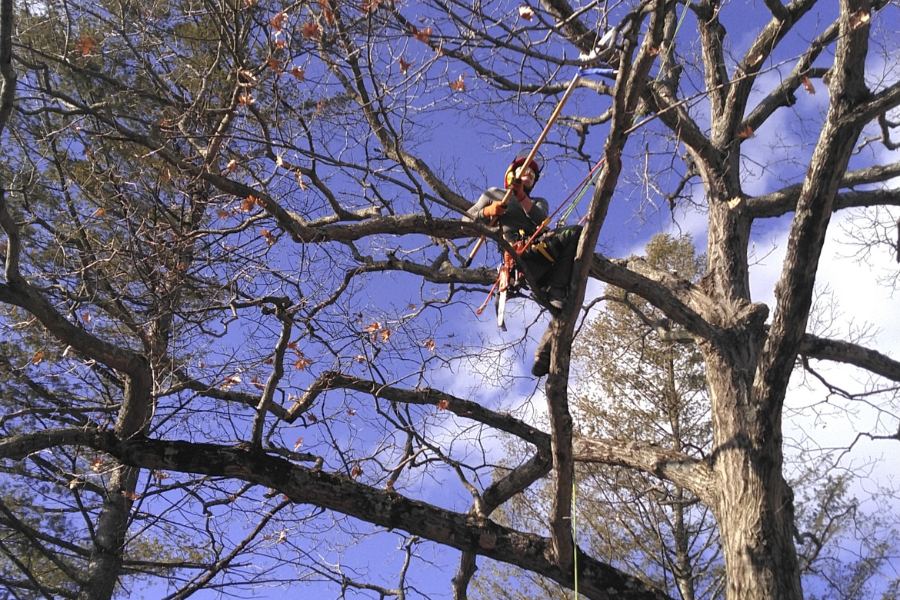
Spike-less pruning uses climbing ropes, harnesses,and advanced climbing techniques that allow arborists to safely access a tree without puncturing the bark.
This approach allows arborists to:
- Safely reach pruning locations
- Protect tree bark and vascular tissue
- Minimize stress on the tree
- Preserve long-term tree health
- Follow professional industry standards
For trees that are being maintained rather than removed, spike-less climbing is widely recognized as the preferred method.
Why Proper Pruning Matters
Tree pruning is about much more than simply removing branches.
Proper pruning can help:
- Improve tree structure
- Remove dead or damaged limbs
- Reduce storm damage risk
- Increase clearance from structures and utilities
- Improve airflow throughout the canopy
- Support long-term tree health
Just as important as which branches are removed is how the work is performed. Proper climbing and pruning techniques help ensure that maintenance benefits the tree rather than causing unintended harm.
Why Hiring a Certified Arborist Makes a Difference
Not all tree service companies follow the same standards.
Certified arborists receive specialized training in tree biology, pruning techniques, tree risk assessment, and proper maintenance practices. Their goal is not simply to complete a job, but to help trees remain healthy, safe, and structurally sound for years to come.
When evaluating tree care providers, it’s worth asking how they access trees during pruning and whether they use spike-less climbing techniques on healthy trees.
The answer can tell you a great deal about their approach to tree care.
Schedule Professional Tree Pruning in Greene County, NY
At Powell’s Tree Care, we believe healthy trees deserve healthy pruning practices. Our team follows industry standards and uses professional climbing and pruning techniques designed to protect the long-term health of your trees.
Whether you need routine pruning, hazardous limb removal, storm damage cleanup, or a professional tree assessment, we’re here to help.
Contact Powell’s Tree Care today to schedule an estimate and learn how proper pruning can help protect your trees for years to come.